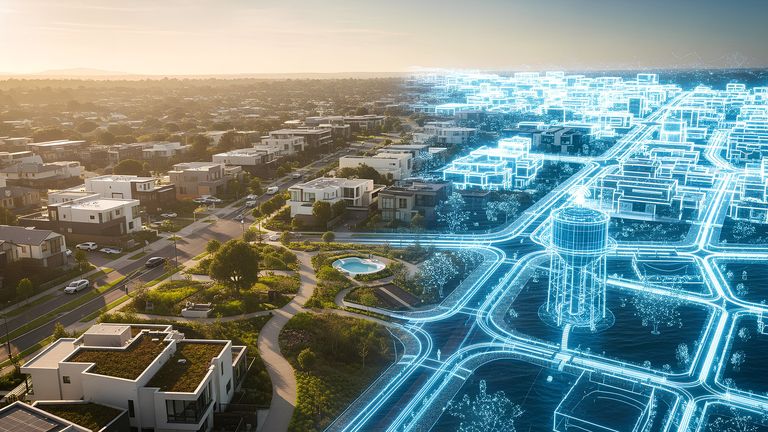
Beyond the Surface: Why 'Blue Tech' is the Next Frontier for Digital Twins and Spatial Computing
The Data Gap No One Is Talking About
We have better maps of Mars than we do of our own ocean floor. The U.S. Geological Survey has said as much. (Note that "mapped" is a relative term: we have 100% of our ocean floor mapped, but only 25% at the higher resolution that we have for all of Mars). Now extend that logic to what's underground — our aquifers, our aging water pipes, our stormwater systems — and you start to understand the scale of what we don't know about the resource that keeps civilization running.
In January, the United Nations declared that the world has entered an era of "global water bankruptcy." Not a temporary drought. Not a regional shortage. A persistent, structural failure of the systems that store, move, and deliver fresh water. Nearly 75% of the world's population now lives in countries classified as water-insecure or critically water-insecure. More than 70% of the world's major aquifers are in long-term decline. Over half the planet's large lakes have lost water since 1990. As the lead author of the report, Kaveh Madani, put it: "For much of the world, 'normal' is gone."
Here in the United States, the problem hides in plain sight. The US Water Alliance and DigDeep published the most comprehensive analysis of domestic water access to date, and the findings are damning: more than two million Americans still live without running water or indoor plumbing. Race is the strongest predictor of whether a family has a working tap — indigenous households are 19 times more likely than white households to lack running water. And as the report pointed out, federal data collection doesn't even capture the full scope of the problem. You can't manage what you can't measure, and right now, we're barely measuring.
Organizations like DigDeep and the US Water Alliance are working hard to close that gap. But the data infrastructure underneath all of it — the sensing, the modeling, the visualization — remains dangerously thin.
Climate Adaptation Is No Longer a Side Conversation
For most of the last decade, climate tech meant mitigation: cutting emissions, scaling solar, electrifying fleets. That narrative is shifting under our feet. ICL Group's "Climate Tech Trends 2026" report makes the case plainly — climate adaptation has crossed the threshold into an investable category. The question isn't just "how do we hit net zero?" anymore. It's "how do we survive what's already here?"
Investors are turning toward water technology, fire and flood analytics, and agricultural resilience — not out of altruism, but because the math demands it. McKinsey estimates the climate resilience market could reach between $600 billion and $1 trillion by 2030. Water infrastructure is listed right alongside flood management and disaster prediction as a priority. And yet, dedicated resilience funding remains a fraction of what's gone into decarbonization. The capital hasn't caught up to the need, which is exactly the kind of imbalance that creates outsized opportunity for those who move early.
The signals go beyond private equity. This month, the Green Climate Fund approved a $250 million program targeting glacier-fed river basins in Central Asia and Pakistan. The UNFCCC has named digital twins, AI, and remote sensing as essential technologies for building adaptive water systems. Water is the new carbon — and the market around it is just beginning to take shape.
What "System Intelligence" Actually Looks Like
This is where our industry needs to pay attention.
The tools that the creative technology sector has spent a decade building — real-time 3D engines, spatial computing platforms, digital twin architectures — aren't just useful for games and film anymore. They are exactly the tools the water sector needs, and it's time the broader industry recognized that.
Traditional water management still runs on fragmented SCADA systems, manual inspections (we're talking literal clipboards), and siloed datasets that don't talk to each other. Smart water infrastructure changes the game: IoT sensors, 5G connectivity, AI-driven analytics, real-time visualization. Sure, getting a 40-year-old pump sensor to talk to a modern data collection system is a challenge, but the piece that's still missing is the human interface. The part that turns a flood of sensor data into something an operator, a mayor, or a community board member can actually understand and act on.
That's what real-time engines do. That's what spatial computing is for. Not "Systems Monitoring," but Systems Intelligence: continuous, predictive, spatial, and legible to more than just engineers.
Bentley Systems is already streaming infrastructure models into Unreal Engine for stakeholder collaboration. Cesium's integration with Google 3D Tiles enables photorealistic digital twins of entire urban environments overlaid with real-world data. A team in China's Yangtze River Delta built a full UE5-based digital twin for water conservancy hubs — real-time water level monitoring, fluid simulation, sluice station visualization — using the same Niagara particle system that powers cinematic VFX. This month, a University of Twente researcher completed the first Engineering Doctorate on a digital twin prototype that predicts groundwater levels in real time, enabling cities to respond before a drought or flood event instead of after.
This isn't theoretical. The technology exists. The question is whether the water industry — and the creative technology industry — will connect the dots fast enough.
The Equity Problem Built Into the Data
Technology without equity is automation of the status quo. And the status quo in water is deeply, structurally unequal.
A February 2026 report from the United Nations University surfaced something that should bother anyone building systems in this space: not a single one of the 11 indicators for SDG 6 — the Sustainable Development Goal for Clean Water and Sanitation — is related to gender. The monitoring framework that's supposed to track global progress on water access is, in practice, gender-blind. Less than half of the 109 countries reporting on water governance even mention women's participation in their policies.
The real-world cost of that blind spot is enormous. Women and girls are responsible for water collection in 7 out of 10 households that lack on-premises water. Girls are nearly twice as likely as boys to carry that burden, losing hours every day that could be spent in school. In India, drought-driven water scarcity has been shown to trigger devastating coping mechanisms — pulling girls from education, pushing families toward early marriage.
This matters for the technology we build because the design of data collection systems is policy. What a digital twin measures, how it visualizes that information, and who gets to interact with it shapes what decision-makers see and what they ignore. If the next generation of water monitoring tools doesn't incorporate gender-disaggregated data from the start, it will simply digitize the same blind spots that have excluded women from water governance for decades. Inclusive data architecture isn't an add-on. It's a design requirement for systems that actually deliver results.
The Market No One Is Competing In
Let's be direct about the commercial opportunity here, because "Blue Tech" is not a philanthropic exercise.
The extended reality market — VR, AR, mixed reality, spatial computing — is projected at $346 billion in 2026. The smart water management market hits $22.6 billion this year and is headed toward $50 billion by 2033. Climate resilience technology, broadly, could be a trillion-dollar category by the end of the decade. Each of these sectors is growing fast on its own. But almost no one is working at the intersection of all three — applying creative technology and spatial computing to water systems with resilience and equity at the center.
That's not a gap in the market. That's a wide-open field.
McKinsey's framing is worth repeating: climate resilience is a market inefficiency. Private capital still accounts for a sliver of resilience investment, while the need runs into the trillions. The organizations and companies that move into this space now — building the visualization platforms, the community-facing interfaces, the simulation and planning tools — won't just be contributing to a better world. They'll be first movers in one of the largest infrastructure transitions of our lifetime.
What Comes Next
Kaveh Madani, the lead author of the UN water bankruptcy report, offered a metaphor that the entire infrastructure and technology sector should take seriously: "Bankruptcy is not the end of action. It is the start of a structured recovery plan — you stop the bleeding, protect essential services, restructure unsustainable claims, and invest in rebuilding."
Rebuilding water systems for the 21st century requires more than pipes and pumps. It requires spatial data, real-time simulation, inclusive design, and the kind of immersive visualization that this industry already knows how to build. The water sector needs what we have. The investment thesis is there. The moral case has been there for a long time.
The question isn't whether "Blue Tech" will happen. It's whether we'll be the ones who build it, or whether we'll watch from the sidelines while the opportunity — and the crisis — passes us by.