Case study · Five59 Labs · 2026
RuzgarOS Publishing System
One writer, five outlets, and a publishing system where Claude does the research, the checking and the scheduling, and every editorial call waits for my yes.
What it is
RuzgarOS is the publishing system I built to run five outlets on my own: a personal essay site, a news and advocacy site, a magazine and two podcasts. Every source, citation, draft, image and social post for all five lives in one plain-text Obsidian-style vault. Claude does the research, the fact checking and the scheduling around the writing, with Gemini Notebook and Perplexity helping on the research. At every point where an editorial call has to be made, the system stops and waits for me.
The problem
Five outlets is a newsroom's worth of work with one person in it. Each has its own voice, its own readers, its own corpus of research, perspectives, institutional knowledge and editorial calendar. The news site covers politics, where a wrong date or a quote pinned to the wrong person costs trust that takes months to win back.
The writing is the part only I can do. Everything around it is real work too: finding sources and reading them, checking every claim against what the source says, picking an image and clearing its rights, writing the SEO fields, scheduling the posts, and rechecking the facts the night before something goes live. Done by hand, that work eats the writing hours first.
So the design question was narrow. Which parts of publishing can a model do well enough to trust, and where does a person have to stay in the loop, every time, with no way around it?
The system
The vault is a folder of markdown files, synced by Syncthing between my local workstation and my self-hosted Linux server. Everything else reads and writes that folder.
- pubtools, a TypeScript CLI, knows the content schemas, piece codes and the lints for voice, citations, briefs and the knowledge base. It's also the only thing that talks to the outside world: Directus for the sites, Postiz for social, Kit for email, Kutt for short links, and several places for sourcing images.
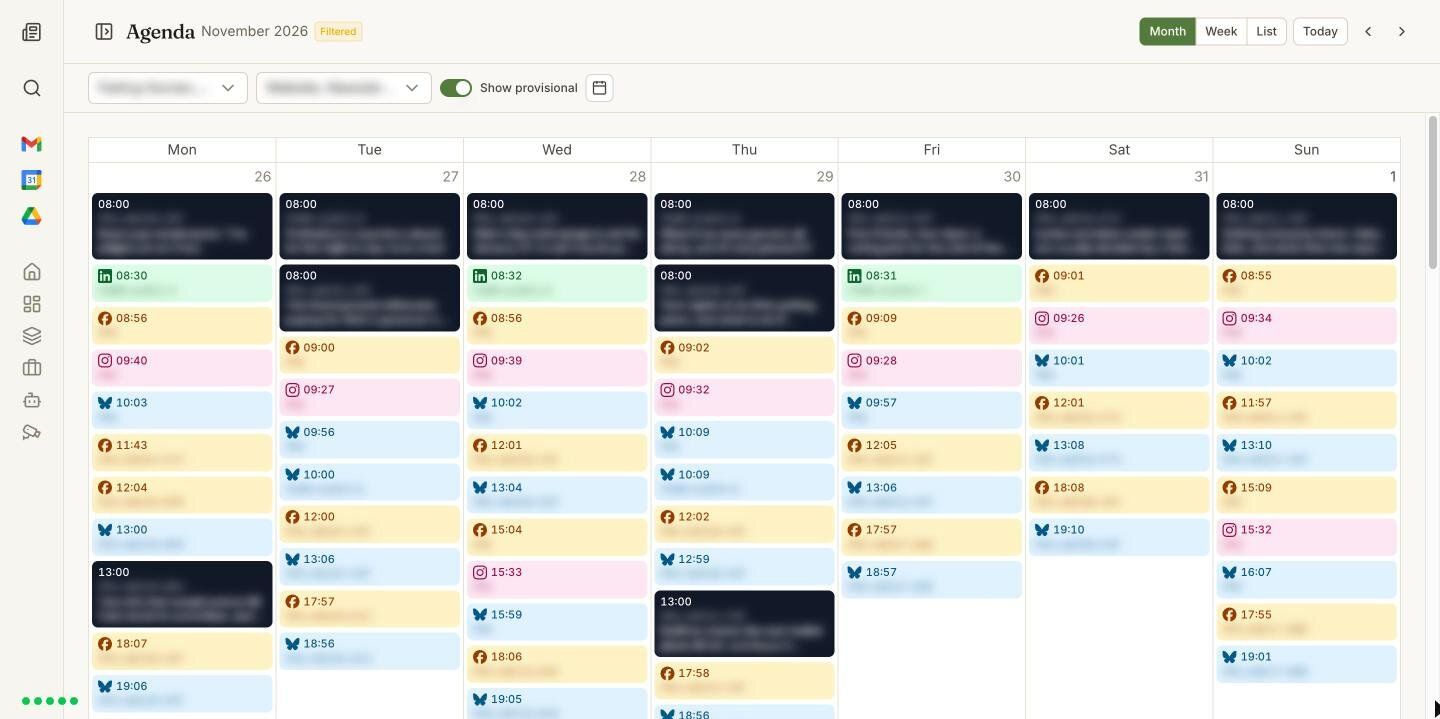
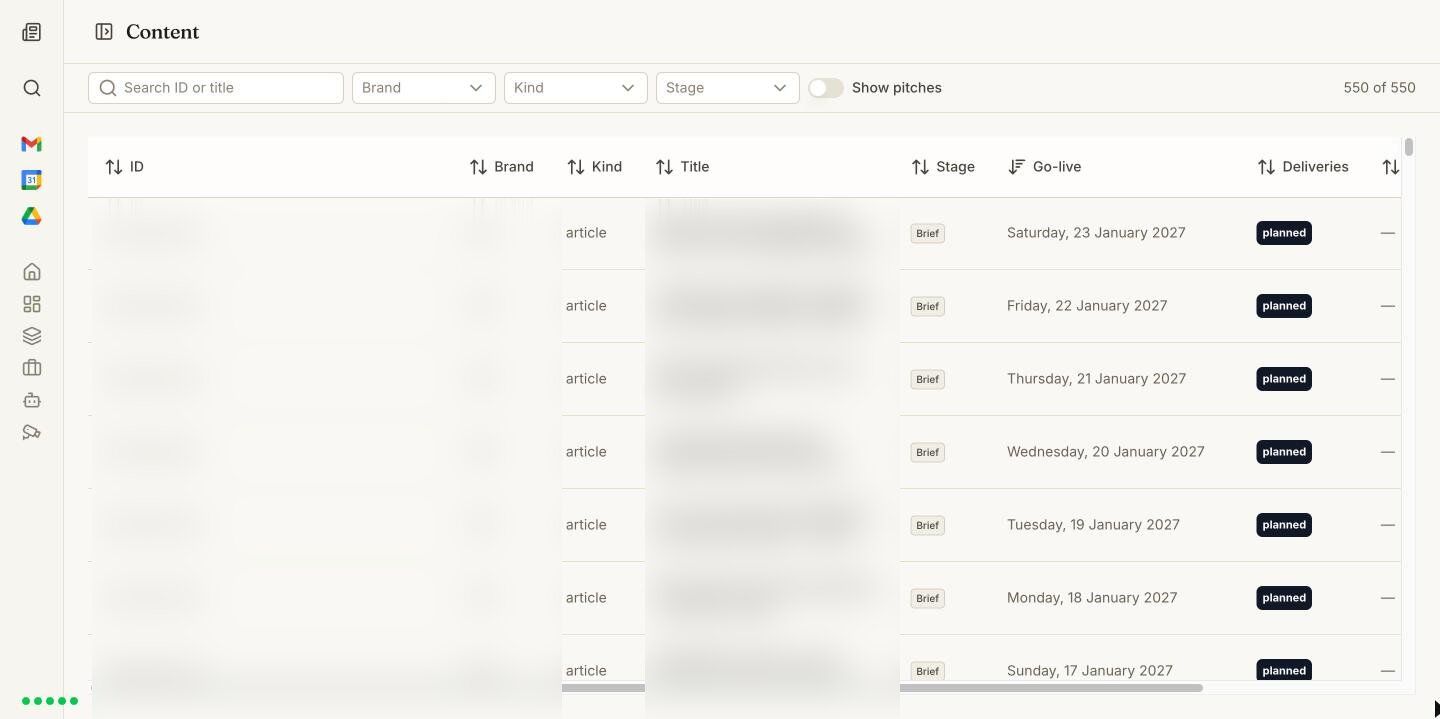
- The Dashboard shows the agenda across all five outlets, a browser for each knowledge base, an idea board and the production stages for the podcasts.
- The runner on my server runs headless Claude Code on a schedule: the daily ingest, the daily link-backs between essays, and the weekly self-review.
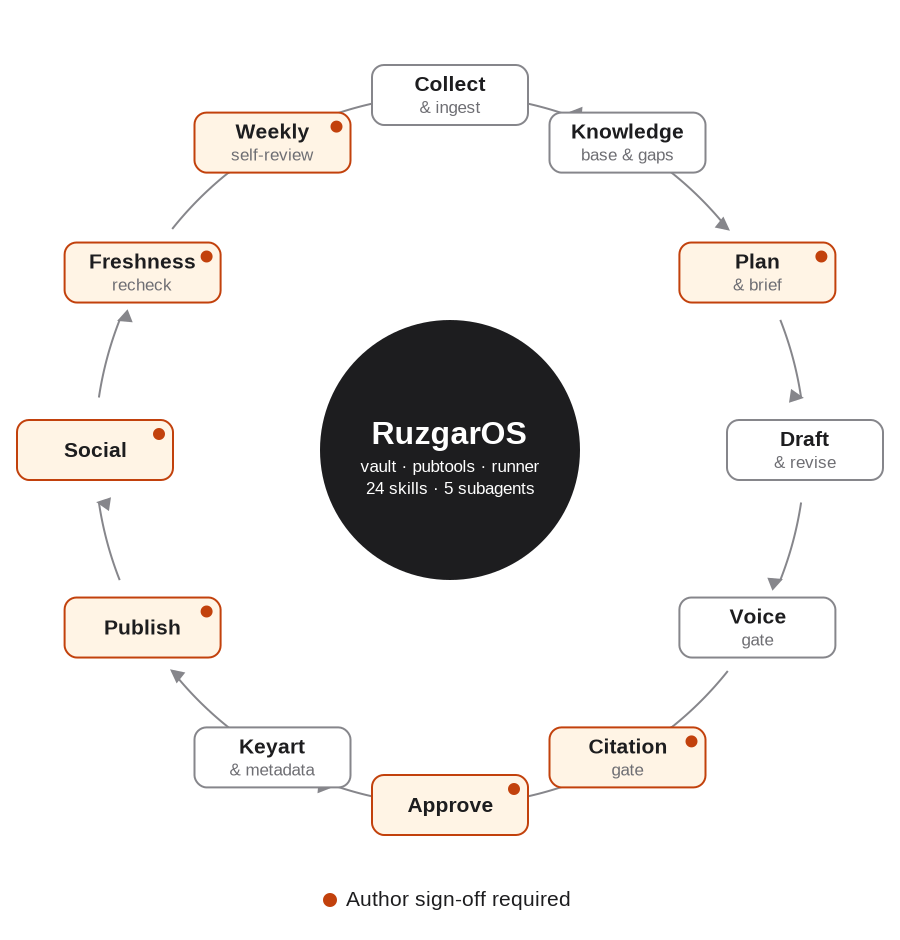
- Twenty-four Claude Code skills carry the twelve stages, and five subagents make the judgment calls a regex can't: whether a source supports a claim, whether a sentence needs to be clarified, whether a page is the real article or a paywall.
The 360° pipeline
A piece moves through twelve stages, and the loop closes on itself. Seven of them are hard stops, marked on the diagram: nothing moves past them without my explicit yes. The weekly review of how the work went feeds changes back into how the next week's work gets collected.
| Stage | What the machine does | What I decide |
|---|---|---|
| Collect & ingest | Fetches each page honestly (no faked browser identity, Chrome as the last resort), files it as a source with its metadata, updates the knowledge-base pages it touches | What's worth clipping, and what to drop when a page can't be read |
| Knowledgebase & gaps | Lints each knowledge base and opens a gap for anything thin, stale, unsourced or contradictory | Which gaps get researched and which close as won't fix |
| Plan & brief | Proposes a dated slate from the knowledge base and the calendar, then writes a brief whose every anchor fact names its source | Each item on the slate, one at a time, and the angle |
| Draft & revise | Revises with me, and opens a gap for any claim the knowledge base can't support | The draft, and every change to it |
| Voice gate | Runs the voice lint (banned words, reading level, etc) and the voice-checker subagent | The judgment calls the lint leaves |
| Citation gate | The citation-verifier subagent reads every citation against its source and the paragraph that uses it | Each citation, shown to me in full, marked reviewed only on my yes |
| Approve | Shows the whole piece with its metadata and citations, and sends any citation whose text changed back through review | Approval |
| Keyart & metadata | For the news site, searches three image libraries and loads a shortlist into a picker; writes title, excerpt, SEO fields, slug and a publish time. It checks specs to ensure it fits within the rules | The image, with one click |
| Publish | Shows the exact Directus row, image, citations and live URL before anything is written | Go, typed in the session |
| Social | Drafts posts per channel and format, lints them, builds the images, puts the whole batch in front of me | The batch, with its exact copy and images, before Postiz gets any of it |
| Freshness recheck | The evening before a piece goes live, spot-checks its claims against the knowledge base and the web | Clear it, or send it back to drafting |
| Weekly self-review | At 4:00 a.m. every Sunday, reads the week's sessions with me and the overnight jobs, and proposes fixes, revisions and new features, each with its evidence | Each fix, accepted or rejected; rejections are logged so they don't come back |
Planning
Planning starts from the research. It has fixed blocks on my calendar every week, and the news site plans ten days out, which leaves room to react when the news moves. A skill called pub-plan reads the outlet's knowledge base, its open gaps, the research opportunities logged against it, whatever came into the Inbox lately, the pieces already on the calendar and the outlet's posting rhythm. From that it proposes a dated slate. Each piece gets a title, an angle and a date, and names where the idea came from: a gap, a research opportunity or a specific source. The magazine starts somewhere else, from an idea board built on a survey of the ground it wants to cover, and its slate draws on the ideas I've already moved forward there.
I take the slate one item at a time. I can keep a piece, drop it, or change its angle or its date, and anything I don't answer stays unapproved. Only then does the system create the piece's folder and code and start on the brief. The podcasts get undated episode concepts instead, because recording sets their schedule.
The system reviews itself
Every Claude session I run in the vault leaves a transcript, and so does every job the runner runs overnight without me. Those transcripts show exactly where the process breaks down. I correct Claude. A skill points the wrong way. A command fails and gets worked around. A gate trips on the same thing for the third time that week. A memory note turns out to be stale. Until November, all of that disappeared when the session closed, unless I wrote it down at the time. I mostly didn't.
Now a skill called pub-dream reads them instead. Every Sunday at 4:00 a.m. the runner exports the week's sessions, strips out any secrets, and gives each transcript to its own small Haiku subagent. Each one looks for five kinds of change: memory to add or correct, skill steps that misled, tools that failed or don't exist yet, voice and citation rules that misfire, and friction that wastes turns. A Sonnet organizer merges what they find, drops anything I've already rejected, ranks the rest and writes one report. Every item carries its evidence (the session and the line that shows the problem), the exact change and the file it would touch.
Nothing changes on its own. The next time I open a session, Claude tells me a review is waiting, and we go through it one item at a time. I accept, reject or defer each one, and Claude applies only what I accept. A rejection goes into a decisions log with my reason, so the same suggestion doesn't come back without new evidence. Code changes the review can't make itself go onto the build list, which is how bug reports and new features find their way into the next round of work.
The first four runs, nightly while I tuned it, read 101 sessions and proposed fifty-seven changes. I accepted forty-nine. Six of the eight I rejected had already been fixed by the time I read them, which tells me the report runs a little behind and is looking in the right places. It also caught a date helper that had returned a day two weeks in the past, and the voice lint flagging a state supreme court's name as a title case error. Both are on the fix list. Some of the system is solid. Some of it I'm still finding out about the hard way, which is why it watches itself.
Built for trust
I'm writing a book about trust and AI, and this system is where I test the argument on myself. Any piece the machine touches has to show its working.
Every citation in the vault names the claim it supports and the role it plays, quotes its source word for word wherever the source allows, and carries a reviewed flag that only flips when I say yes. None of the skills can approve a piece, publish one or schedule a post on their own say-so. Each of those steps prints a plan first and waits for my confirmation in the session. The weekly review follows the same rule: it can propose a change to the system, and only I can make it happen.
Outcomes
I wrote the design spec on 19 October 2026. The core of the system was working three days later. In the month since, I've designed and built thirteen more subsystems on top of it: migrations, podcast publishing, social scheduling, self-hosted short links, faceted knowledge-base browsing, an idea board and the weekly self-review. That's 497 commits to RuzgarOS so far.
All five back catalogs moved into the one vault, and 348 published pieces now live there. The knowledge bases hold about 6,400 sources, and the system has opened 951 gaps against them. Since 23 October, sixty-three pieces have gone through the full pipeline, fifty-two of them already live and the rest scheduled, carrying 955 citations between them. I've reviewed every one, and 934 of them carry a verbatim quote from their source.
What's next
Right now planning works from what I've researched and what's still missing. What landed with readers last cycle isn't part of it yet. The essay site's page views and referrers already sit in Umami, and the history of every social post sits in Postiz. The next piece I'm building pulls both into planning: a review of what resonated in the last cycle, read alongside the newest research, that proposes directions first and a schedule only after I've picked among them. Same rule as everywhere else in the system. The machine brings the evidence, and I choose the direction.
My role
I designed and built RuzgarOS end to end: the spec, the architecture, pubtools, the dashboard, the runner, the skills and subagents, and the deployment on my own hardware, working with Claude Code as my build partner. I'm also the editor and the writer for all five outlets, which means I'm the person every gate is waiting on.
In one line
A publishing system where the machine does the legwork and every piece still has to get past me.